
This page provides an overview of solar panel manufacturers with sustainability data per panel (series). By filtering and searching specifically, you can easily determine which panels meet the set of procurement criteria for sustainability.
The Sustainable Solar Panels Guide is intended as an independent tool to help users make a broader and more informed decision when choosing solar panels. The Guide provides an overview of various sustainability aspects and is expressly not intended as a binding assessment of products, manufacturers, or brands.
When assessing the sustainability of solar panels, it is important to consider multiple sustainability criteria in conjunction with one another. The carbon footprint is an important criterion in this regard, but on its own it does not provide a complete picture of a solar panel’s sustainability. Other aspects, such as circularity, lifespan, material use, the presence of harmful substances, supply chain transparency, social conditions in the production chain, and other relevant sustainability indicators also play an important role. Read more.
This version is updated until October 1st, 2026. Feedback, additions, and corrections are welcome and can be emailed to solarpv@pianoo.nl. You can also use the template for the Request for information to provide additional information.
- Explanation
- Carbon
Footprint - PFAS-free
- Antimony free
- Leadfree
- Take-back guarantee
- Recyclability
- Lifetime
- Forced labour risk
The table shows manufacturers with panel series per row. If there are clearly different series regarding one or more sustainability criteria, multiple rows per manufacturer are filled in. In total, the table contains 59 different manufacturers. More background information is available per topic. Choose a term to read the explanation.
Most of the Carbon Footprint (CO2 emissions – CFP) comes from the production phase, especially during the extraction and production of (poly)silicon and solar cells, as a lot of electricity is required here. How this required electricity is generated (fossil or green) also determines the final CFP. There are different ways to determine this CFP: via a simplified method (“Evaluation Carbone Simplifiée” – ECS) or from a Life Cycle Analysis (LCA), recorded in an Environmental Product Declaration (EPD). Two standards are relevant here: EPD Global (previously EPD Norway) and EPD Italy. EPD Italy is less useful because it also accounts for the total estimated yield of the solar panels over their lifespan (based on various assumptions). EPD Global focuses on the lifecycle of the panel itself. For an extensive explanation of the different methodologies, see the Copper8 research report (Chapter 2, only in Dutch).
The table uses the CFP value of GWP for the production phase (A1 through A3) in kg CO2-eq/kWp, if a LCA or an EPD Global is available. If no EPD is available, the maximum values from the ECS methodology (range) are used. If neither is available, this is indicated with “unk.”
Most solar panels contain PVDF (Tedlar), PVF (Kynar), or other fluorinated polymers and coatings. These PFAS materials can be released into the environment during production or use (through powder formation or peeling) and cause health hazards. Some PFAS are also on the REACH Candidate List (SVHC): this list includes substances identified as “substances of very high concern” and that may be added to the REACH Authorization List in the future. Manufacturers must inform customers if their product contains more than 0.1% of these specific substances. For some solar panels, PFAS-free alternatives incur little to no additional costs. For others, PFAS-free alternatives have not reached sufficient technical viability. Glass-glass panels are PFAS-free.
Antimony is a heavy metal with toxicity comparable to lead. It is added by glass producers (especially in China) during glass production; 40-80 grams per solar panel to make the front glass ultra-transparent. There are also ways to achieve this without adding antimony or other heavy metals. During the usage phase, at most a small fraction of antimony can end up in the environment. The main problem with antimony is that it complicates high-quality recycling of the glass. When panels are produced in China, they almost always contain antimony unless explicitly stated otherwise by the manufacturer. If the amount of antimony is specified, less than 0.05% by weight is considered antimony-free.
Lead is found in solder and is cheap and reliable. A standard solar panel contains 5 to 15 grams of lead. Some manufacturers already use lead-free solder. Although reducing or phasing out lead is generally a good choice, it should not lead to poorer solder connections and thus a shortened lifespan. Although still limited, lead recycling is possible for some manufacturers—these are marked as “YES*” in the list, where * stands for: “The lead is fully recyclable and can be reused.” This can therefore be assessed in a similar way to “completely lead-free.” For awareness, it is useful to mention the amount of lead on the datasheet.
A limited number of manufacturers offer their own take-back guarantee and closed-loop recycling. If this is verifiably implemented, the presence of hazardous substances and heavy metals is less of a concern. This does not apply to PFAS, as these substances can already be released into the environment through degradation during the product’s lifespan.
In addition, in the Netherlands, the statutory Legal Producer Responsibility applies to anyone who markets solar panels. Manufacturers and importers must register for this through Stichting Open. It is expected that all brands on the list are registered, either directly or through importers..
Currently, there is no clear methodology for determining the Recyclability of solar panels. Various indicators can be used for this, including those from the CINEA report (Nov 2025). Work is currently underway to define the specific details of these criteria.
At present, a limited number of manufacturers hold Cradle-to-Cradle certification for their solar panels. One of the aspects of this, is recyclability. In some cases, the certificate has expired, but there are still panels on the market that were manufactured while the certificate was valid. It is up to the purchasing organization to verify this specifically. The table indicates whether the C2C certificate is valid or has expired.
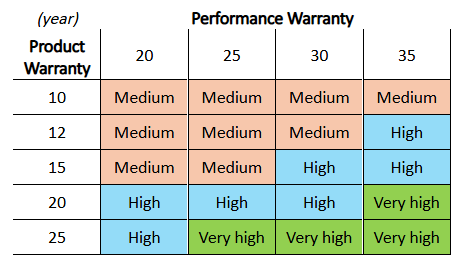
There are two types of warranties issued by the supplier: the performance warranty period and the product warranty period. There is a reasonable consensus regarding the performance warranty period based on various technical field tests, and this period is also used in the preparation of the EPD. This period is usually between 25 and 30 years, with a minimum of 80% of the original performance value at the end-of-life. The product warranty period is usually (much) shorter (often 12 to 15 years), which is largely due to liability and legal considerations on the part of the manufacturer. However, some manufacturers also offer a longer product warranty (sometimes up to 30 years). The table combines both warranties according to the scheme below to provide an accurate picture of the expected lifespan.
In various industrial sectors, including the solar industry in (particularly) China, there are significant abuses with regard to working conditions: these mainly, but not exclusively, concern (risks of) forced labour by Uyghurs in the western province of Xinjiang. Various studies have been published demonstrating this, including the earlier report by Sheffield Hallam University (2023) and the most recent Globalworks reports (2026). There are also several other sources of information that can be used to assess the risk of forced labour, including an AI-tool that focuses on information published on the internet about this topic.
It is important that the principles of due diligence are applied during the procurement process. This includes, among other things, a risk analysis, discussions with suppliers, and collaboration with other supply chain partners to increase leverage. In tender procedures, bidders can be asked about their due diligence policies and practices. For this purpose, the standard ISV tender specifications (Netherlands) can be used and/or input from the most recent Guide for Responsible Procurement of Solar Panels (Scandinavia).
In the Netherlands, companies and civil society organizations from the renewable energy sector work together in the International RBC Agreement for the Renewable Energy Sector to collectively address, tackle and, where possible, prevent supply chain risks, including working conditions and environmental damage. This work follows the OECD Human Rights Due Diligence guidelines.
There is also the multi-stakeholder initiative Solar Stewardship Initiative (SSI), since 2021. Within this initiative, SSI standards have been established to assess sustainability (ESG) and supply chain transparency (SCT) in the solar supply chain. For each affiliated manufacturer, it is possible to determine how many production sites are certified and for which topic (ESG and/or SCT).
Finally, the EU Forced Labour Regulation (FLR) is in full preparation. Via the EU Forced Labour Single Portal, a database of products can be consulted that may no longer be placed on the European market as of 14 December 2027. At the time of this update of the Guide, the FLR database is not yet operational.
To assess the risk of forced labour in the production of the panels mentioned in this Guide, the following classification is used:
- Low risk: in the case of a (demonstrably) fully non-Chinese supply chain and/or full transparency that no forced labour is taking place in the chain
- Medium risk: in the case of a (partially) Chinese supply chain, but where the manufacturer can demonstrate that various improvements in the supply chain have been structurally implemented
- High risk: in the case of a fully Chinese supply chain, and/or when the producer is explicitly named in the aforementioned studies or database(s)
- Unknown (unk): when it is entirely unknown where production takes place
| Producer | Panel series/name | Carbon Footprint | Source CFP | PFAS-free | Antimony-free | Leadfree | Take-back guarantee manufacturer | Recyclability | Lifetime | Forced labour risk |
|---|---|---|---|---|---|---|---|---|---|---|
| A1-A3 kg CO2-eq/kWp | Yes / No / unknown | Yes / No / unknown | Yes / No / unknown | Yes / No | Cradle-to-Cradle certificate | Very high / High / Medium | High / Medium / Low / unknown | |||
| Aiko | Axxx-MAH72Mw, Axxx-MAH54Mw, Axxx-MAH54Mb, Gxxx-MCH72Mw | 517 | EPD-G | unk | No | unk | No | No | High | High |
| Aiko | Axxx-MAH72Dw, Axxx-MAH54Dw/Db, Gxxx-MCH72Dw, Axxx-GRH66Dw, Axxx-GCH66Dw, Axxx-MAH60Dw/Db, Axxx-MCE54Dw/Db, Axxx-MAE78Dw, Axxx-MAH78Dw, Axxx-GTE66Dw, Axxx-MDE72Dw | 506 | EPD-G | Yes | No | unk | No | No | High | High |
| Aleo | LEO-N series | unk | unk | Yes | unk | unk | No | No | Very high | unk |
| AstroEnergy (Chint) | CHSM78RN(DG)/F-BH, CHSM48RN(DG)/F-BH, CHSM48RN(DG)(BLH)/F-BH, CHSM48RN(DGT)(BLH)/F-BH, CHSM54RN(DG)/F-BH, CHSM54RN(DGT)(BLH)/F-BH | 361 | EPD-G | unk | No | unk | No | No | Medium | High |
| BelgaSolar | Solar Panel Design 425 | 430 | 424 | LCA | unk | unk | Yes * | Yes | No | Very high | Laag |
| BelgaSolar | Solar Panel Performance 450 | 414 | LCA | unk | unk | Yes * | Yes | No | Very high | Laag |
| Biosphere Solar | ReModule 1.4 IBC | 400 | Statement | Yes | Yes | Yes | Yes | No | Medium | Laag |
| Biosphere Solar | ReModule 1.4 TOPCON | 630 | Statement | Yes | No | No | Yes | No | Medium | High |
| BISOL | BDO Duplex, Bifacial, Supreme, Spectrum | 582 | EPD-G | unk | No | unk | No | No | Very high | High |
| Boviet Solar (Inox Solar) | (PERC) BVM 7612M-xxx-H-HC, (TOPCon) BVM 7612M/7610M/7609M-xxx-H-HC | unk | EPD-I | unk | unk | Yes | No | No | Medium | High |
| Boviet Solar (Inox Solar) | (PERC) BVM 7612M-xxx-H-HC, (TOPCon) BVM 7612M/7610M/7609M-xxx-H-HC | unk | EPD-I | Yes | unk | Yes | No | No | Medium | High |
| Canadian Solar Inc. (CSI) | CS-7N-TB-AG, CS7L-XXX TB-AG, CS6.2-66TB, CS6.2-66TB-H1 | 630 | ECS | Yes | No | unk | Yes | No | Medium | High |
| DAH Solar | R18/R20–Nxx series | 303 | EPD-G | Yes | No | unk | Yes | No | High | High |
| DAS Solar | DAS DHxxNE | 630 | ECS | Yes | No | unk | Yes | No | High | High |
| DMEGC Solar | M10RT-54HXX, M10RT-60HXX | 466 | EPD-G | unk | No | unk | Yes | No | Very high | High |
| DMEGC Solar | M10T-B72HXX, M10T-B78HXX, M10RT-B54HXX (-U), M10RT-B54-LU (L), M10RT-B60HXX (-U), M10RT-B60HXX-LU (L), G12RT-B66HXX, G12T-B66HXX | 456 | EPD-G | Yes | No | unk | Yes | No | High | High |
| DMEGC Solar | G12RT-B48HBB | unk | unk | Yes | No | unk | Yes | No | Very high | High |
| EgingPV | EG-XXXM54-HLV, EG-XXXM54-HL/BF-DG, EG-XXXM72-HLV, EG-XXXM72-HL/BF-DG, EG-XXXM60-HUV, EG-XXXM60-HU/BF-DG, EG-XXXM66-HUV, EG-XXXM66-HU/BF-DG, EG-XXXNT54-HLV, EG-XXXNT54-HL/BF-DG, EG-XXXNT72-HLV, EG-XXXNT72-HL/BFDG, EG-XXXNT66-HU/BF-DG, EG-XXXNT48-HRC/BF-DG, EG-XXXNT66-HRC/BF-DG | unk | EPD-I | unk | unk | unk | Yes | No | High | High |
| Elsun | GB Premium | unk | unk | unk | unk | unk | Yes | No | Very high | unk |
| Energyra | alle | 486 | LCA | Yes | Yes | Yes | No | No | Very high | Laag |
| First Solar | Series 7 thin film | 235 | EPD-G | Yes | Yes | Yes | Yes | No | Medium | Laag |
| FuturaSun | FUxxxM Silk® Nova, FUxxxMV Silk® Nova | 591 | EPD-G | No | No | unk | No | No | High | High |
| GB Sol | diverse series | unk | unk | unk | unk | unk | No | No | Very high | Laag |
| GCL | NT12(R)/BDF, NT12(R)/GBDF | 740 | ECS | Yes | No | unk | No | No | Medium | High |
| Gokin Solar | diverse series | unk | unk | unk | No | unk | No | No | High | High |
| Green Energy | CIGS 310-75, 150 | 341 | EPD-G | unk | Yes | Yes | No | No | n.b | unk |
| Hanwha Solutions / Qcells | Q.TRON S-G3R.12+ / BFG, Q.TRON BLK S-G3R.12+ / BFG | 740 | ECS | Yes | No | unk | No | No | Very high | High |
| Heliatek | alle | 250 | Statement | unk | Yes | Yes | No | No | Medium | Laag |
| Heliene | diverse series | unk | unk | Yes | unk | unk | No | No | Medium | Laag |
| Huasun | HS-210-B132DSxxx | 385 | EPD-G | Yes | No | unk | No | No | High | High |
| Huayao PV | HYxxx-N132CDD, HYxxx-N132EDD, HYxxx-N144BDD, HYxxx-B144DDD, HYxxx-N156BDD | 375 | EPD-G | Yes | No | unk | No | No | High | High |
| JASolar | JAMxxS30/MR, JAM54S31/MR, JAMxxS30/LR, JAM54S31/LR, JAMxxS30/GR | 336 | EPD-G | unk | No | unk | No | No | Medium | High |
| JASolar | JAMxxD40/MB, JAMxxD42/LB, JAM66D45/LB, JAMxxD40/GB, JAM54D41/GB, JAMxxD40/LB, JAMxxD41/LB, JAM66D42/MB, JAM54D40/LR, JAM54D41/LR | 376 | EPD-G | Yes | No | unk | No | No | Medium | High |
| JASolar | JAM72D30/MB, JAM72D30/GB, JAM78D30/MB, JAM72D30/LB | 328 | EPD-G | Yes | No | unk | No | No | Medium | High |
| JinkoSolar | JKMxxxN-66HL4M-BDV (2 productielocaties) | 356 | EPD-G | Yes | No | unk | No | No | Medium | High |
| Jolywood Solar | JW-HD serie | 443 | EPD-G | Yes | No | unk | No | No | High | High |
| Kaylon | Double glass Perc series | 489 | EPD-G | Yes | unk | unk | No | No | Medium | unk |
| Kaylon | N-Type TopCon series | 229 | EPD-G | Yes | unk | unk | No | No | Medium | unk |
| Leapton Solar | LP182*210-M-XX-NB-series | 391 | EPD-G | Yes | No | unk | No | No | Very high | High |
| Longi | LR5-54HIH, LR5-54HPB, LR5-54HPH, LR5-54HTB, LR5-54HTH, LR5-66HIH, LR5-66HPH | 550 | EPD-G | Yes | No | unk | No | No | Medium | High |
| Longi | LR8-66HGD AND LR7-72HYD | 355 | EPD-G | Yes | No | unk | No | No | Medium | High |
| Longi | LR8-66HYD | 312 | EPD-G | Yes | No | unk | No | No | Medium | High |
| Longi | LR5-72HGD, LR7-72HGD | 355 | EPD-G | Yes | No | unk | No | No | Medium | High |
| Longi | LR7-72HVH, LR7-54HVH, LR7-72HVD, LR7-54HVD, LR7-54HVB | 321 | EPD-G | unk | No | No | No | No | Medium | High |
| Midsummer | Bold | 113 | EPD-G | unk | Yes | unk | No | No | Very high | Laag |
| Midsummer | Slim | 117 | EPD-G | unk | Yes | unk | No | No | Very high | Laag |
| Midsummer | Wave | 156 | EPD-G | unk | Yes | unk | No | No | Very high | Laag |
| PhonoSolar | PSXXXM4-20/UH, PSXXXM4-22/WH, PSXXXM4-24/TH, PSXXXM6-20/UH, PSXXXM6-22/WH, PSXXXM6(H)-24/TH, PSXXXM6(H)-22/WH, PSXXXM6(H)-20/UH, PSXXXM6(H)-18/VH | 836 | EPD-G | unk | No | unk | No | No | Medium | High |
| PhonoSolar | PSXXXM8GF(H)-24/TH, PSXXXM8GF(H)-22/WH, PSXXXM8GF(H)-20/UH, PSXXXM8GF(H)-18/VH | 815 | EPD-G | Yes | No | unk | No | No | Medium | High |
| PhonoSolar | PSXXXM8GF(H)-24/TNH, PSXXXM8GF(H)-22/WNH, PSXXXM8GF(H)-20/UNH, PSXXXM8GF(H)-18/VNH | 842 | EPD-G | Yes | No | unk | No | No | High | High |
| Rec Solar | REC N-Peak 2 | 1340 | EPD-G | No | unk | unk | No | No | Very high | High |
| Recom | Diverse series, 5 verschillende celtechnologieen | unk | unk | No | unk | unk | No | No | High | Laag |
| Risen | RSM110-8-xxxBHDG, RSM132-8-xxxBHDG | 379 | EPD-G | Yes | No | unk | No | No | High | High |
| Risen | RSM132-8-xxxBHDG | 390 | EPD-G | Yes | No | unk | No | No | High | High |
| Risen | RSM132-8-xxxM, RSM132-8-xxxBMDG | 473 | EPD-G | Yes | No | unk | No | No | High | High |
| Smart Solar | Lumina series | unk | unk | Yes | unk | unk | No | No | Medium | High |
| Solarge | SOLO 500 Wp | 452 | LCA | Yes | Yes | Yes * | Yes | Vald | High | Laag |
| Solarge | SOLO 525 Wp | 390 | LCA | Yes | Yes | Yes * | Yes | Vald | High | Laag |
| SolarSpace | SS8-72HD-N, SS9-60HD-N, SS9-66HD-N, SSA-48HD-N, SSA-48HDB-N, SSA-54HD-N, SSA-66HD-N | 362 | EPD-G | Yes | No | unk | No | No | High | High |
| SolarWatt | M5.5, M5.0, L5.0 | 489 | EPD-G | Yes | Yes | Yes | Yes | Expired | Very high | Laag |
| Solitek | SOLID series | 524 | EPD-G | Yes | Yes | Yes | No | Vald | Very high | Laag |
| Solitek | BLACKSTAR en MAGNUS series | 420 | EPD-G | Yes | Yes | Yes | No | Vald | Very high | Laag |
| Soluxtec | RE XSC Series | unk | unk | Yes | unk | unk | No | No | Very high | unk |
| Sonnenstromfabrik | Low carbon serie Excellent | unk | unk | Yes | unk | unk | No | No | Very high | Laag |
| Sonnex Energie | SNX Series HP | unk | unk | unk | unk | unk | No | No | High | unk |
| Sonnex Energie | SNX Series Dual Glass | unk | unk | Yes | unk | unk | No | No | Very high | unk |
| SPIC (Qinghai) | SPICN6(LAR)-66-xxx series | 384 | EPD-G | unk | No | unk | No | No | Very high | High |
| Sunman Energy | e-Arc Lightweight series | 740 | unk | unk | Yes | unk | No | No | Medium | unk |
| Sunova Solar | Tangra series | unk | unk | Yes | No | unk | No | No | High | High |
| Sunova Solar | SS-XXX-54MDH, SS-XXX-54MDH(T), SS-XXX-60MDH(T), SS-XXX66MDH-G12, SS-XXX-72MDH, SS-XXX-72MDH(T), SS-BGXXX-54MDH, SS-BGXXX-54MDH(T), SS-BGXXX-72MDH, SS-BGXXX-66MDH-G12 | unk | EPD-I | unk | No | unk | No | No | High | High |
| TCL Sunpower (Maxeon) | Maxeon SPR3 / Maxeon 6 | 342 | EPD-G | unk | unk | Yes | Yes | Expired | Very high | Laag |
| Tongwei | TWMNH-66HS, TNC-G12R-66 | 451 | EPD-G | unk | No | unk | No | No | Medium | High |
| Tongwei | TWMNH-66HD | 361 | EPD-G | Yes | No | unk | No | No | High | High |
| Tongwei | TWMNH-48HExxx, TWMNH-48HWxxx, TWMNH-48HDxxx | 493 | EPD-G | Yes | No | unk | No | No | High | High |
| TrinaSolar | NEG9R.25, NEG9R.28, NEG9RC.27, NEG18R.28, NEG18R.20 | 358 | EPD-G | Yes | No | unk | Yes | No | High | Medium |
| Ureco | Recyclable PV Module DEF_R8A / 144 cells 580 W – 605 W | unk | unk | Yes | No | unk | No | No | Medium | unk |
| Ureco | Glory series (FKF4XXBFW-BB, FJF, FBF) | unk | unk | Yes | No | unk | No | No | High | unk |
| Viridian Solar | Clearline Fusion AG M10 | unk | unk | Yes | No | unk | No | No | High | High |
| Viridian Solar | Clearline Fusion M10, G1 | 711 | EPD-G | unk | No | unk | No | No | Medium | High |
| Voltec Solar | TARKA 110/120 VSMP/ VSBP | 630 | ECS | unk | No | unk | No | No | Very high | High |
| Winaico | WST-450NGX-D3, WST-445NGXB-D3, WST-xxxNCX54-AW, WST-xxxNCX48-AW, WST-xxxNCX48-BW | 547 | EPD-G | Yes | No | unk | No | No | Very high | High |
| Wuxi Suntech Power | UltraV Pro | unk | unk | Yes | No | unk | No | No | High | High |
| Yingli Solar | YLM 3.0 Series | unk | unk | Yes | No | unk | No | No | Medium | High |
| Yingli Solar | Panda | unk | unk | Yes | No | unk | No | No | Medium | High |
| ZN Shine Solar | ZXM7-SH108-xxx/M | unk | EPD-I | unk | No | unk | No | No | Medium | High |
| ZN Shine Solar | ZXM7-SHLD144-xxx/M | unk | EPD-I | Yes | No | unk | No | No | Medium | High |
The information on which the table and accompanying notes are based has been compiled from publicly available sources, publicly accessible documentation, and product information made available by manufacturers and other market participants. Where possible, independent and verified data sources, such as Environmental Product Declarations (EPDs) from EPD Global, have been used.
The list was compiled under the responsibility of the Netherlands Enterprise Agency (RVO), the executive body of the Ministry of Economic Affairs and Climate Policy. Although the utmost care has been taken in collecting, interpreting, and processing this information, RVO cannot guarantee its accuracy, completeness, timeliness, or suitability for a specific purpose. RVO remains dependent on the accuracy and completeness of the underlying data published or provided by third parties. Therefore, no rights may be derived from the content of the Guide
Sustainability is a dynamic topic, and the assessment criteria used may therefore be expanded or modified in the future. The Sustainable Solar Panels Guide is thus updated periodically based on new insights, changes in regulations, and newly available information.
The Sustainable Solar Panels Guide is intended solely for personal use. Prior written permission from the Ministry of Economic Affairs and Climate Policy is required for the reproduction, processing, and distribution of the Sustainable Solar Panel Guide beyond the scope of its use for your own purposes. It is not permitted to use the Sustainable Solar Panel Guide for any form of commercialization.
The Dutch Environmental Database
The Dutch Environmental Database (NMD) contains environmental data on building products and materials (including solar panels) that is used to objectively calculate the environmental performance of buildings. The refined A2 score takes into account 19 environmental indicators, some of which align with or overlap with data from the Sustainable Solar Panel Guide. Some solar panel manufacturers have registered their panels in the NMD. See https://milieudatabase.nl/en/viewer/

